
Cutting Commutes, Conserving Power: How the Telecommuting Act Helps Address the Energy Crisis
Facing a global energy crunch and rising fuel prices can feel overwhelming. You're probably wondering how your business can stay resilient and whether there are legal ways to cut costs without sacrificing productivity.
In this comprehensive guide, we'll break down the Telecommuting Act (Republic Act No. 11165) into simple, actionable steps. By the end, you'll understand exactly how to leverage remote work as a strategic energy solution and what legal standards you must follow to stay compliant. If you wish to consult with us, click HERE to schedule a session.
Remote Work: More Than Just a Perk, It’s Power Saved
What is the Telecommuting Act?
At its core, Republic Act No. 11165, or the Telecommuting Act, is a law that allows private-sector employers to offer alternative workplace arrangements. In simple terms, it means work doesn't have to happen in a traditional office to be considered "official"
Why This Matters for the Energy Crisis
Think of every employee's commute as a drain on a finite resource. When staff work from home, the "energy footprint" of a company shifts. Massive office buildings require constant air conditioning, lighting, and elevator power. By adopting telecommuting, companies can significantly reduce their direct energy consumption and operational overhead, effectively turning a labor policy into an environmental and economic shield.
The Legal Framework: Your Implementation Roadmap
Navigating the law doesn't have to be a headache. Many employers worry that remote workers are harder to track or might be treated differently than office staff. To keep things fair and legal, the DOLE Department Order No. 237-22 (The Revised IRR) outlines strict rules built on parity and equal rights.
When you implement a telecommuting program, you must follow these foundational pillars:
The Fair Treatment Principle
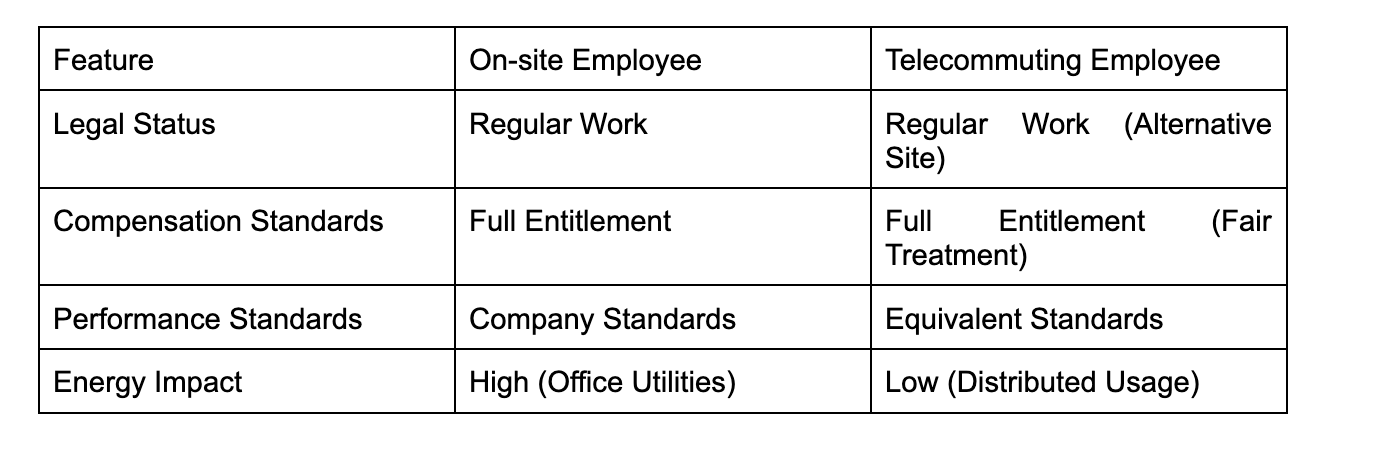
The centerpiece of RA 11165 is absolute equality. A telecommuting employee must receive the same treatment, rights, and protections as a comparable on-site worker. This includes:
Equal Pay and Benefits: Remote workers are entitled to the exact same basic pay, overtime, night shift differentials, and holiday pay as office workers.
Performance & Workload: You cannot give remote employees a higher workload or stricter performance standards just because they are working from home.
Career Advancement: Telecommuters must have equal access to training, promotions, and collective rights (like a CBA).
The "Work is Work" Rules
Hours Worked: Under the Revised IRR, all time an employee is required to be online, on duty, or "permitted to work" counts as hours worked.
Non-Diminution of Benefits: You cannot use a work-from-home setup as an excuse to lower an employee’s current salary, allowances, or benefits.
Setup and Safeguards
It Must Be Voluntary: Telecommuting cannot be forced; it must be mutually agreed upon by you and the employee.
Data Protection: Employers must provide clear guidelines and tools to protect company data, while employees are required to keep confidential information safe. The Data Privacy Act applies here. If you wish to consult with us, click HERE to schedule a session.
Quick Comparison: On-Site vs. Remote Compliance
To keep things clear, let's look at how the law treats both setups side-by-side:
Common Questions (FAQs)
"Can I cancel a telecommuting arrangement if it's not working?"
Yes. Either the employer or the employee may terminate or change the arrangement based on the agreed-upon policy, provided it does not harm the employment relationship.
"Do I have to pay for the employee's home electricity?"
The law requires that the arrangement be at "no cost to the employee" regarding the change in setup. While specific utility stipends are often settled in the individual agreement or CBA, the core principle is that the employee's terms must not be diminished.
Are remote employees exempt from disciplinary action if they disappear?
Not at all. While remote workers enjoy equal rights, they also have equal responsibilities. For instance, in the case of In Re: Benbinuto (2025), the court illustrated that if an employee fails to submit mandatory work-from-home accomplishment reports, it can be legally treated as insubordination.
Ready to modernize your workplace? Consult with a legal expert today to ensure your Telecommuting Policy is both energy-efficient and fully compliant with RA 11165. If you wish to consult with us, click HERE to schedule a session.
Disclaimer: This blog post is for general informational purposes only and does not constitute formal legal advice. For specific compliance and drafting needs, please consult with a qualified attorney.
