
Wake Up Before It's Too Late: Is Sleeping on the Job a Legal Headache Waiting to Happen?
Finding an employee fast asleep during work hours is a frustrating moment for any business owner or manager. Aside from the immediate loss of productivity, it raises serious concerns about workplace safety, morale, and operational integrity.
As an employer, your immediate instinct might be to issue a termination letter. But before you act, you need to know the legal landscape. Is sleeping during work hours a dismissible offense in Philippine labor law?
The short answer is yes but it is not an automatic "one-strike-and-you're-out" ticket to termination.
Whether dismissing an employee for sleeping on duty is legally valid depends heavily on the specific circumstances of the infraction, the nature of the work, and how well you handle the process. Let’s dive into the legal grounds, landmark Supreme Court rulings, and the exact steps you need to take to protect your business. If you wish to consult with us, click HERE to schedule a session.
Sleeping vs. The Law: Where Does the Labor Code Draw the Line?
Under the Labor Code of the Philippines, sleeping during work hours isn't explicitly listed as its own category for termination. Instead, the Department of Labor and Employment and the courts typically evaluate it under Article 297 (formerly Article 282) regarding Just Causes for Termination.
Depending on how you frame and prove the charge, sleeping on duty generally falls into one of two legal categories:
1. Serious Misconduct
To qualify as serious misconduct under DOLE Department Order No. 147-15, the act must be grave, directly related to the performance of the employee’s duties, and show that the employee is deeply unfit to continue working. For example, a security guard sleeping while on duty or a machine operator dozing off next to hazardous equipment severely compromises safety and business operations.
2. Willful Disobedience (Insubordination)
If your company handbook explicitly states that sleeping during work hours is strictly prohibited, a violation can be treated as willful disobedience. According to DOLE rules, this requires proving that the employee intentionally and wrongfully refused to obey a reasonable, lawful, and work-related order (in this case, your company policy). If you wish to consult with us, click HERE to schedule a session.
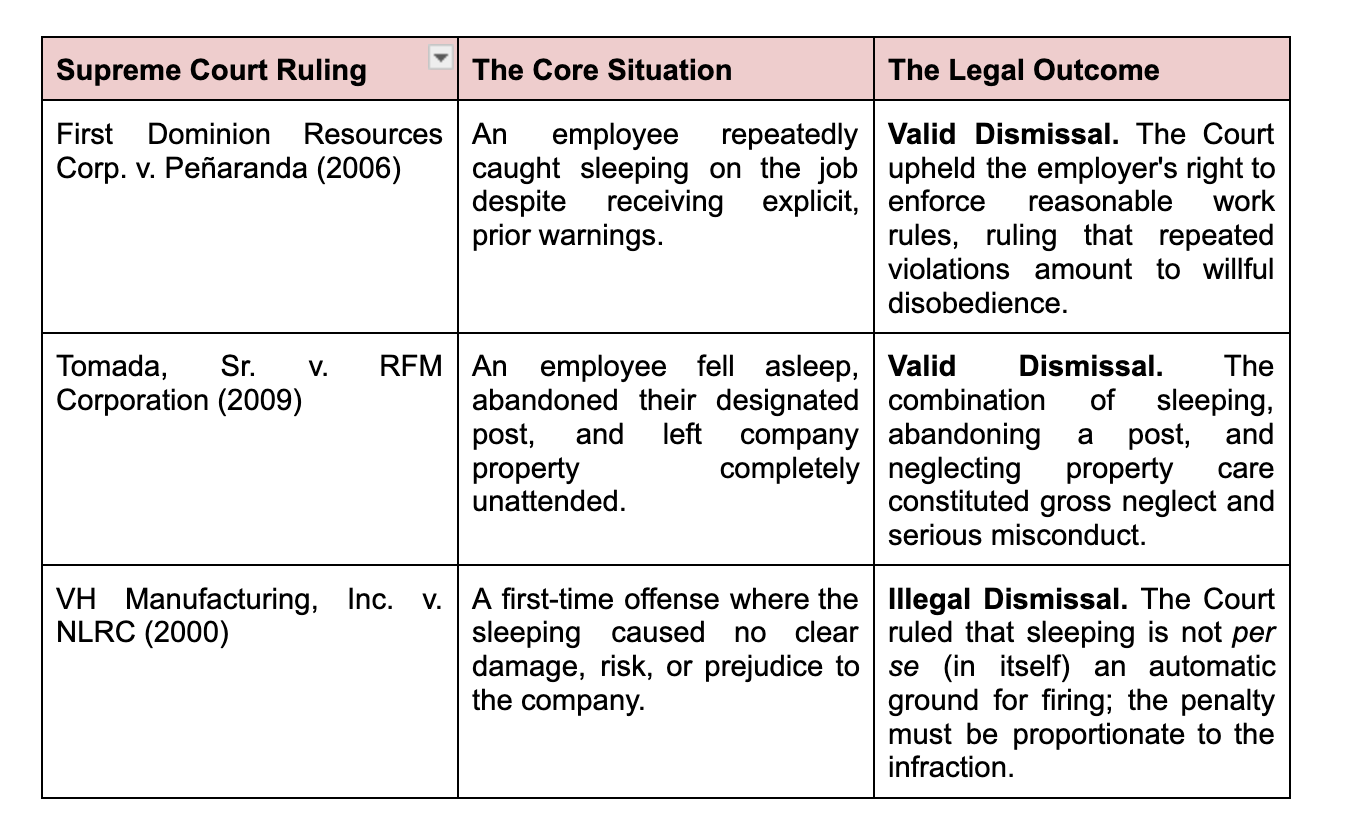
Bulletproofing Your Case: What the Courts Look For
If an illegal dismissal case lands on the desk of a Labor Arbiter, the burden of proof rests entirely on you, the employer. To ensure your disciplinary actions stand on solid legal ground, ensure you meet these four criteria:
Substantial Evidence: You must have clear documentation. An anonymous rumor isn't enough. You need supervisor logs, witness statements, or photographic/video evidence showing the employee was genuinely asleep.
Operational Risk or Prejudice: It is easier to justify termination if the role is safety-sensitive (e.g., drivers, hospital staff, guards) or if the nap directly caused financial or operational damage.
A Clear Company Policy: You must prove the employee knew the rules. Having a signed employee handbook that explicitly outlines policies on sleeping and company discipline is crucial.
Adherence to Due Process: Even with airtight video evidence, skipping procedural due process will result in an illegal dismissal ruling. You must follow the Twin-Notice Rule:
First Notice (Notice to Explain): Detail the incident and give the employee at least 5 calendar days to explain their side.
Administrative Hearing: Offer a formal opportunity to discuss the matter.
Second Notice (Notice of Decision): Inform them of your final, well-considered decision.
Frequently Asked Questions (FAQs)
Can I fire an employee on the spot if I catch them sleeping?
Absolutely not. Terminating an employee on the spot violates procedural due process. You must issue a Notice to Explain and allow them to go through the legal disciplinary process before making a decision.
What if the employee claims they were just "resting their eyes" or on a break?
This is why documentation and clear policies matter. Your company policy should explicitly define where and when sleeping is permitted (such as designated sleeping quarters during scheduled break times). If they are found asleep at their workstation during active operational hours, it remains a policy violation.
Does a first-time offense justify termination?
Rarely. Unless the single incident involved a highly critical safety role that put lives or high-value property at immediate risk, the Supreme Court usually views a first-time offense as a matter for progressive discipline (such as a written warning or suspension) rather than immediate dismissal. If you wish to consult with us, click HERE to schedule a session.
Disclaimer: This article is for general informational and educational purposes only and does not constitute formal legal advice. For specific legal concerns regarding employee discipline and termination, please consult with a qualified labor attorney or legal professional.
